

Most people think airlines make money selling seats, but that's not where most of the profit comes from. In 2025, United Airlines generated $59 billion in revenue and kept just $3.35 billion of it, a razor-thin margin for a company that flew 181 million people.

An overview of the margins at United Airlines
The question is, if the seats weren't driving profit, what was? It turns out, the answer is everything else after you hit purchase.
So earlier this year, I booked a flight on United to Hawaii to break down the genius lifecycle program behind one of the iconic travel companies.
This is the story of why United's profit has less to do with selling airplane seats and a lot more to do with lifecycle marketing.
The experiment
I’ve been wanting to do an airline breakdown for a while, ever since I watched a fascinating video about frequent-flyer programs. And one of the perks of working at Hightouch is that we do yearly off-sites to gather the whole company together. This year’s was in Hawaii.

That’s me in the red circle.
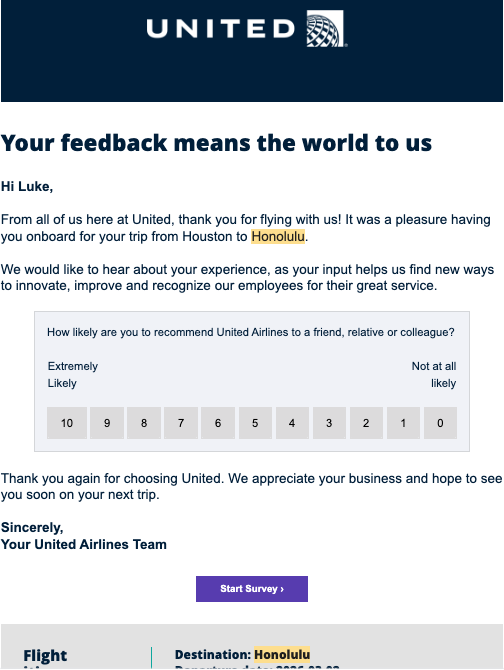
So, being the lifecycle marketer I am, I took it upon myself to save every message that United sent me from the moment I purchased my ticket to the moment I stepped on the plane. What I uncovered was a 14-email journey that explained the entire paradox of how airlines barely break even on flying but generate billions in profit.

Every email I received from the moment I booked to the moment I landed.
But before I break down the actual lifecycle strategy, you first have to understand the invisible business model behind United because every lifecycle message is designed to power a machine most people will never see.
The economics of United
Airline travel is a brutal business model because the entire product is a commodity. Every carrier sells pretty much the exact same thing on the surface: a seat on an aircraft to a location somewhere in the world. For a customer like myself, affinity and loyalty are fickle, and I can easily be swayed by price, layovers, time, and other convenience factors. And when you operate a fleet of over 1,000 aircrafts like United, every unsold seat represents revenue you can never recover.
It was such a big problem that when COVID struck in 2020, it grounded the entire fleet and revenue collapsed entirely. United needed money, and they needed it fast. So they did the only thing they could do. They opened the books on their MileagePlus program to borrow against it. The program was so valuable that the company was able to raise $6.8 billion.
In fact, MileagePlus was valued at roughly 12 times their 2019 earnings, which worked out to nearly $22 billion. For context, that was more than the entire airline was worth on the stock market at the time. In fact, the filing showed a 34% margin on the MileagePlus program compared to a 6% margin on the airline business. Which means the loyalty program is far more profitable than the flying business it’s attached to.

The valuation of Mileage Plus vs. United Airlines in 2020
The MileagePlus playbook
If you’ve ever flown United, then you’re probably already familiar with MileagePlus, which rewards members with airline miles or flying and spending, so you can later redeem those miles for free flights, seat upgrades, or various other travel perks. For a customer, it’s a great exchange because you’re rewarded for brand loyalty.

For United, it’s also a great exchange because rewarding you costs far less than you’d imagine, since the plane will fly the route whether it's full or not — and the fuel, crew, and gate costs are already being paid for. That means the marginal cost to give away a seat on a flight that would have departed with an empty row is close to zero.
But that’s only half of it, because miles wouldn’t be that useful if there wasn’t a way to monetize them. And this is where the genius of airline miles comes into play because United sells miles to partners. And the biggest buyer, by far, is Chase, the exclusive credit card partner to United.
Every time someone swipes a United credit card, Chase buys those miles from United to hand them to the cardholder as a reward. That same model applies to other United partners like car rentals, hotels, etc. And most miles aren’t actually earned by flying; they’re earned by spending, which means most miles are ones a partner has already paid for.

In 2020, 71% of the program’s cash came from third parties like Chase. And the major advantage here is that United collects all of that cash up front before any miles are actually redeemed. This way, United is able to receive money upfront for travel not yet taken. It’s a rewards program for members and a currency program for partners, and United is the one that sets the price on both sides. In 2025 alone, this program generated roughly $3.2 billion in revenue.
The ancillary offer playbook
Selling miles is one engine. Ancillary revenue is the other, and it works in the opposite direction. Where miles are the currency United sells to partners, ancillary offers are what United sells directly to you: checked bags, premium seats, upgrades, Wi-Fi, and priority boarding. All the extras are layered on the ticket you already bought.
It runs on the same logic as the miles, though. That premium seat or upgrade was likely going to fly empty anyway, so it costs United almost nothing to sell it to you. Which means the margins are enormous.
In 2025, United made $4.8 billion in ancillary fees. To put that in perspective, United's entire operating profit that year was $4.7 billion. Nearly all of it is sold in the window between the moment you book and the moment you board. And that sliver of time is owned by the lifecycle marketing team.
The impact of these 2 programs
Ok, but why on earth does all this matter? When you add up the revenue driven by these two engines, it’s $4.8B in ancillary fees and another $3.2B in miles sold to partners. And remember, these two programs operate at much higher margins than standard ticket sales. To really ground this for you, If you strip out the $8B fueled in large part by the lifecycle program, that number drops to negative $3.3B.

Note: Obviously, the math isn’t quite this simple and I’m definitely no accountant, but I’m doing my best to share some rough estimates directionally based on all the publicly available 1st-party information without knowing the exact margins on everything in 2026.
Inside the lifecycle program
To synthesize this down more succinctly, United has two main ways to make money off a trip you've booked: MileagePlus and ancillary offers. But neither system works unless customers actually find them worth engaging with. Partners only buy miles if members genuinely value and use them.
And the team that makes all of this appealing to consumers is the lifecycle marketing team, which manages every message across every owned channel (email, SMS, push, etc). The goal is simple: make travel absolutely seamless.
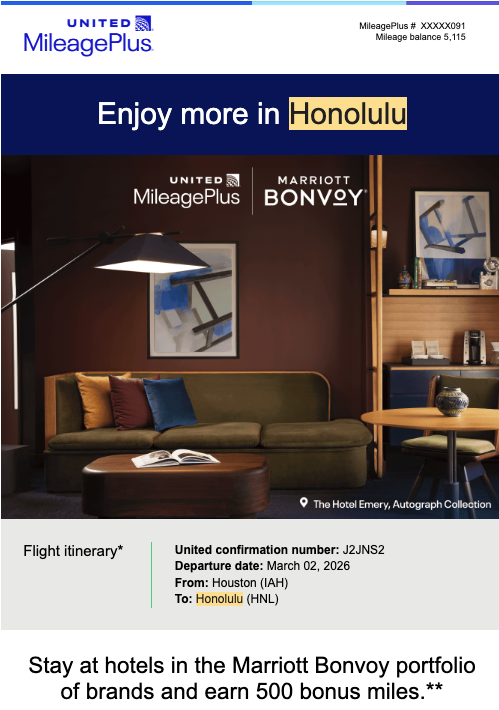
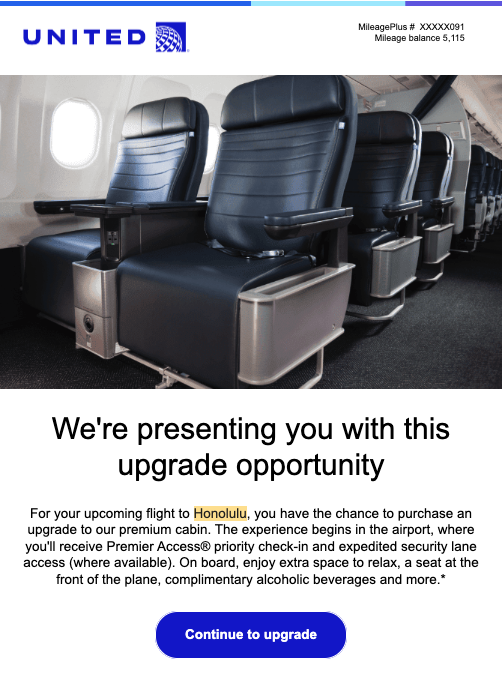
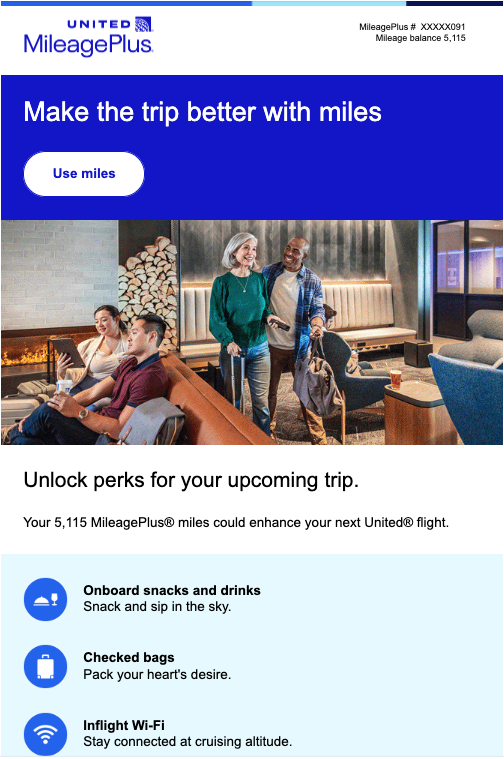
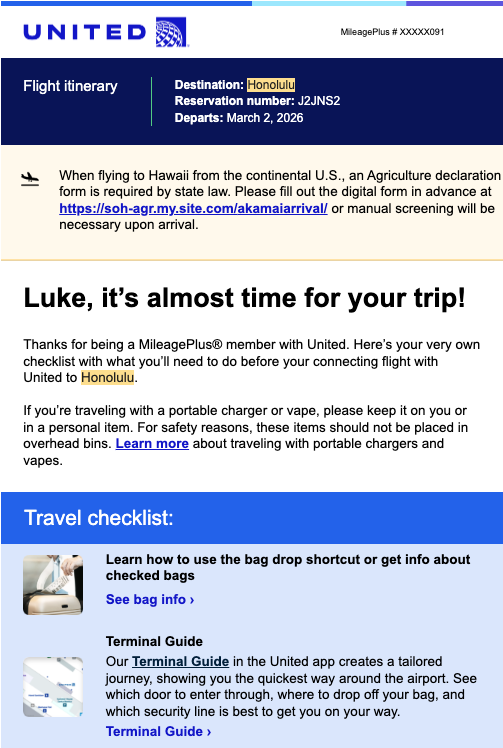
The moment you book a United flight, you're enrolled in an automated sequence that runs for weeks leading up to departure. I saved all 14 emails United sent me for my trip to Honolulu, and after mapping them out, the whole program organizes around a handful of core messages.
Each one serves a specific function:
| ||
| ||
| ||
| ||
| ||
|

And here’s how they all break down from a calendar standpoint:

An overview of United’s 14 email lifecycle sequence
The entire program comes down to three things:
Simplicity: Each template has one job and one CTA. No message tries to do two things at once. It’s intentionally simple because simple is the only way to scale reliably when you’re dealing with the type of volume that United is.
Journey-based timing: The sequence triggers based on your booking and follow your trip. Early emails help you plan. As departure nears, they shift to the flight itself. The message you get depends on where you are in the travel journey.
Dynamic personalization: Every template merges in your real account data: destination, origin, Premier status, and live mileage balance.
The lesson for your own program
The more I analyze lifecycle programs at enterprise brands, the more I’m convinced that their focus is on building simple and maintainable systems that are optimized for driving specific outcomes. United is able to monetize travel engagement to be profitable.
The lifecycle team didn't build United's network, and they’re not the sole reason why partners purchase miles. But they largely control the two levers that drive margin for the company: the attach rate on everything sold between booking and boarding, and the perceived value of the currency.
It’s a good reminder that oftentimes, much of marketing is journey-based. Often, the most effective lever you can pull as a lifecycle marketer is simply delivering the right message to customers on the right channel at the right time, and ultimately providing real value to help them solve real problems.
You don’t always need another experiment or a more clever program. Figure out the one moment your customer is most likely to act, build a simple system that meets them there every time, and let it run. Then start optimizing and refining it.
And remember, doing the simple things right is actually quite challenging.
Sources & methodology: The financial figures here are pulled directly from United's own filings and investor materials. Current numbers (revenue, margins, ancillary and loyalty revenue, passenger counts) come from the FY2025 10-K. The standalone MileagePlus economics (the 34% margin and the 71% third-party cash figure) come from the MileagePlus investor presentation United published in 2020, the one time they opened the program's books. The ~$22 billion valuation comes from United's June 2020 8-K, which states that multiplying MileagePlus's 2019 EBITDA by 12 equates to a valuation of approximately $21.9 billion. The $6.8 billion the company raised against the program is from United's June 2020 financing announcement. The lifecycle breakdown comes from the 14 messages I saved from my own trip.