

Most lifecycle teams size experiments after they commit to building them. By then, it's too late to cut the bad ones.
Allison Bryant, Sr. Manager, Lifecycle Marketing at GlossGenius, built a Claude skill that runs the math upfront, and she was kind enough to share what she built and how she uses it. With that, I'll let her take it from here:
The problem: too many experiments, no sizing
" My team has a TON of experiment ideas. We needed a way to quantify which ideas have the best shot at driving the biggest impact, so we could prioritize them.
Impact sizing in 2 minutes instead of 1 hour
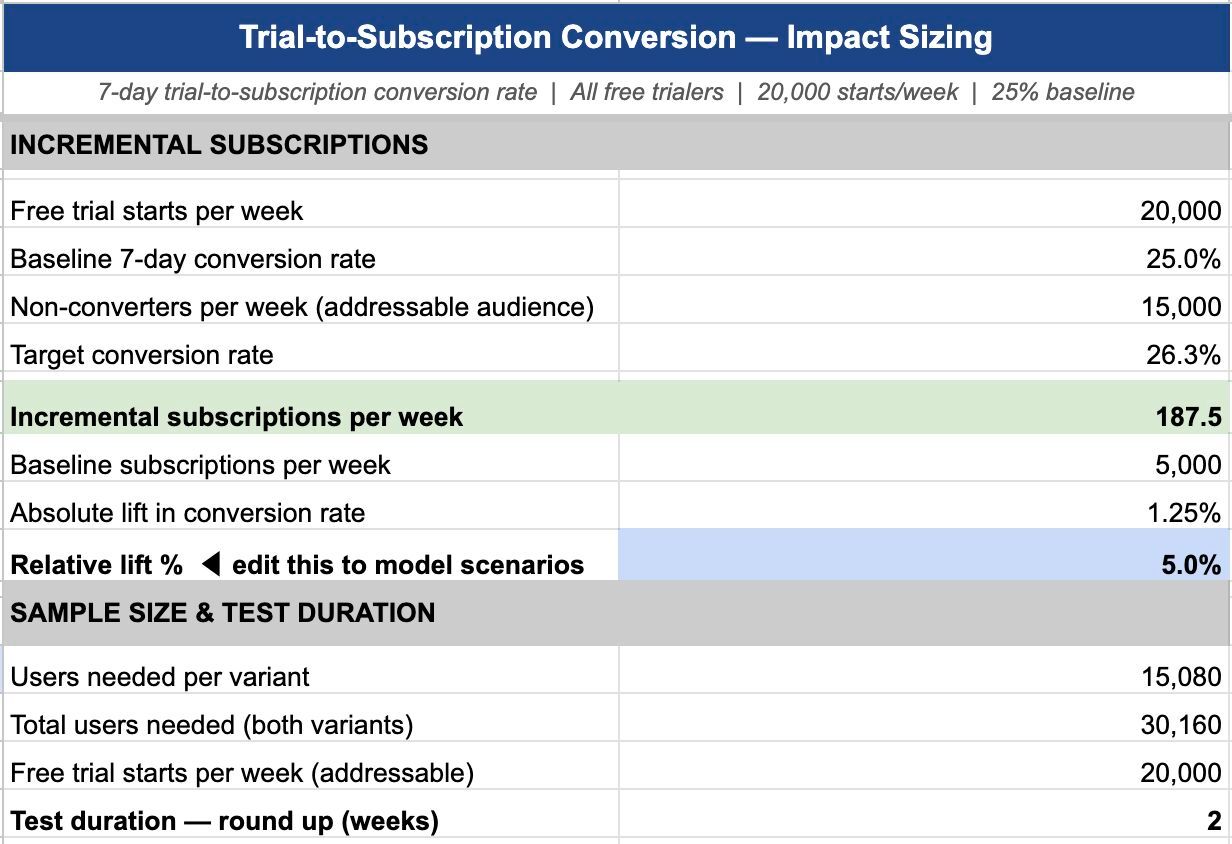
" The Impact Sizing skill takes a campaign brief (or a quick back-and-forth conversation) and builds a fully formula-driven spreadsheet model to predict the conversion impact of a test idea. It handles three model types automatically: single-metric experiments, two-metric funnels, and promotional revenue viability with sensitivity analysis. What would normally take 30-60 minutes of spreadsheet setup (getting the formulas right, color-coding inputs vs. outputs, adding notes, building a sensitivity table) comes out in under two minutes as a clean, ready-to-share .xlsx file.
Evaluating a real onboarding intervention
" I used it to evaluate two potential interventions in upfunnel actions during our onboarding flow (should our first message drive users to download our app or to set up their booking site?) I gave it the audience sizes, baseline conversion rates of the upfunnel actions, and the rate at which users who performed the upfunnel actions subscribed. The model showed me that 5% lift in one metric resulted in 20% more conversions than the other, making my decision easy.
What you need before you start
" You'll need to know your own baseline conversion rates, audience sizes, etc., to make full use of this skill!
The bottom line
Most teams treat metric definition and audience sizing as a box to check after the experiment is already on the roadmap. Running this skill upfront forces that conversation earlier.
" We can figure out which experiments will help us hit our goals faster.